Austerlitz
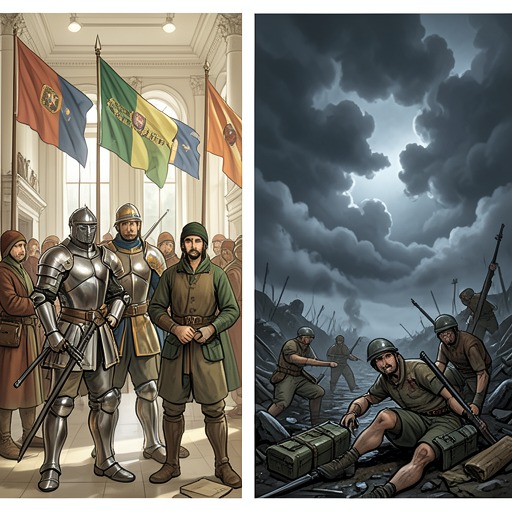
War and PeaceAusterlitz is the setting of the Battle of Austerlitz, the so-called battle of the three Emperors, and one of the most consequential military locations in the novel. It is where the grand language of strategy meets exhausted bodies, confusion, wounds, and death. The battle’s significance lies not only in its outcome—the loss suffered by the Russian and allied forces—but also in the way the location transforms Prince Andrei Bolkonsky’s understanding of glory, command, and human greatness.
Strategic Setting and Historical Scale
Austerlitz appears within the vast military movement of the Napoleonic Wars. The opposing forces are presented not as a simple expression of individual decisions but as the product of innumerable human actions, fears, desires, and institutional pressures. The narrative compares this accumulation to the mechanism of a clock: countless wheels and pulleys move, yet the visible result is merely the slow movement of the hands. In the same way, the passions and sufferings of 160,000 Russians and French culminate in the loss of the Battle of Austerlitz, a movement on the dial of history.
This interpretation challenges the idea that a battlefield can be understood through the will of a single commander. The battle is framed as the outcome of continuous historical motion, while commanders and emperors are only selected figures within that larger movement. Austerlitz therefore functions as a testing ground for the novel’s account of historical causation: its result cannot be reduced to one plan, one error, or one heroic act.
The wider military context is already marked by logistical strain. In October 1805, the Russian army occupies Austrian villages and towns, while newly arriving regiments gather near Braunau under the command of Mikhail Kutuzov. One regiment, after a twenty-mile march, is kept awake through the night cleaning and repairing itself for inspection. Its two thousand men are made to appear perfectly ordered, with every button and strap in place, although more than half their boots are full of holes after a march of roughly seven hundred miles. The contrast between ceremonial appearance and material deprivation anticipates the later reality of Austerlitz, where formal military order cannot conceal exhaustion and disorder.
The Battle and Its Immediate Environment
The battle is preceded by the movement of troops through a landscape whose roads, villages, heights, and frozen watercourses become instruments of danger. When Nikolai Rostov is sent to find Mikhail Kutuzov and the Emperor near Pratzen, he discovers neither the commanders nor an orderly headquarters. Instead, the roads are filled with carriages, Russian and Austrian soldiers, wounded men, and confused crowds moving under the fire of French batteries stationed on the Pratzen Heights.
Pratzen is thus not a distant strategic label but a visible and threatening presence. Rostov repeatedly asks where the Emperor and Kutuzov are, yet receives no coherent answer. A soldier finally tells him that they have all gone, laughing as he breaks free of Rostov’s grasp. Rostov sees French cannon and French troops where he had been ordered to look for the Russian command, but he cannot accept the evidence of defeat. His inability to believe what is before him gives the location a psychological dimension: Austerlitz is the place where patriotic expectation collides with the physical facts of a collapsing army.
The retreating crowds encounter an even more immediate hazard at a frozen pond. Soldiers rush onto the ice while shouted orders urge them forward. The ice gives way beneath the leading men, a gun driver hesitates, and then a larger section collapses, sending roughly forty soldiers into the water. Cannon balls continue to fall among the men on the dam, the pond, and the bank. The scene shows how military momentum can become mechanically self-destructive: orders continue even when the ground, the crowd, and the visible danger demand hesitation.
The Battle of Austerlitz follows a campaign already shaped by retreat and attrition. Earlier actions at Lambach, Amstetten, and Melk had been fought with courage and endurance, but their practical consequence was a still more rapid Russian withdrawal. Mikhail Kutuzov’s force had been reduced, Austrian troops had separated from it, and the defense of Vienna had become impossible. Austerlitz therefore emerges from a chain of strategic reversals rather than as an isolated contest between equally prepared armies.
Prince Andrei Bolkonsky on the Battlefield
Prince Andrei Bolkonsky’s decisive experience at Austerlitz occurs on the Pratzen Heights, where he falls with the flagstaff in his hand. He lies bleeding and unconscious, uttering a gentle, piteous, childlike moan. The battlefield initially strips away the identity through which he had imagined himself: the officer seeking distinction, the man attracted to the idea of personal glory, and the participant in a world organized around rank and command.
When consciousness returns, the first reality that reaches him is suffering. He feels a burning, lacerating pain in his head and looks toward the lofty sky above him. The sky, which he had not known until that moment, appears immense, clouded, and blue beyond the drifting formations. His recognition is not a military revelation but an existential one. The battlefield’s apparent importance recedes before the permanence and vastness of the sky, while his former understanding of glory is rendered small and unstable.
Napoleon Bonaparte then rides over the field with two aides-de-camp after giving orders to strengthen the batteries firing at Augesd Dam. Looking at a dead Russian grenadier, Napoleon remarks, “Fine men!” The comment turns the dead into objects within the conqueror’s visual field, while the wounded Prince Andrei lies nearby, unable at first to identify the voices or the personage above him. The scene places imperial spectacle beside individual vulnerability and makes the supposed greatness of the commander appear radically different from the suffering experienced beneath him.
For Prince Andrei, the location produces a reversal in values. The action that might have made him memorable becomes the occasion for disillusionment. The flagstaff in his hand, the battlefield, Napoleon’s presence, and the lofty sky combine to expose the inadequacy of heroic ambition when measured against pain, mortality, and the indifference of the larger world.
Command, Communication, and Confusion
Austerlitz is also a place where military knowledge becomes fragmented. Before the battle, Prince Andrei senses that Mikhail Kutuzov is dissatisfied and that the headquarters surrounding Emperor Alexander I treat Kutuzov as someone excluded from information possessed by others. Prince Andrei seeks details from Prince Mikhail Dolgorukov because he wants to understand what is being prepared, but the very atmosphere of command is one of competing confidence, concealed knowledge, and uncertain authority.
The battlefield later converts this uncertainty into physical disorganization. Rostov encounters soldiers and officers who do not know where their commanders are, roads obstructed by vehicles, wounded men mixed with combatants, and fire falling into the retreating mass. The distinction between planned movement and panic becomes difficult to sustain. Austerlitz therefore reveals the limits of command as a system of transmission: an order may be issued at headquarters, but its meaning changes as it passes through fatigue, terrain, missing officers, frightened soldiers, and the pressure of pursuit.
The language surrounding war also exposes competing national and social positions. At a Russian gathering, a patriotic German colonel recites the official reasons for the declaration of war, invoking the safety and dignity of the empire and the sanctity of its alliances. Such formulations attempt to give coherent political meaning to the conflict. At Austerlitz, however, the lived result of those abstractions is a road full of wounded men, unanswered questions, and soldiers drowning beneath broken ice.
Narrative Significance and Aftermath
Austerlitz is the location where the novel most forcefully joins military history to private consciousness. Its historical scale encompasses emperors, armies, batteries, and the movement of nations; its intimate scale is concentrated in Prince Andrei Bolkonsky’s wounded body and changed perception. The location makes the two scales inseparable. The battle is historically decisive, but its deepest narrative consequence is the collapse of a personal ideal of greatness.
The location also supports the novel’s critique of heroic history. Austerlitz is not represented as a clean demonstration of superior will. Its outcome is shaped by exhaustion, inadequate equipment, retreat, confused communication, and the momentum of masses that no individual fully controls. Even the spectacle of imperial authority is surrounded by dead and wounded men whose experiences cannot be contained by official explanations.
Its significance continues beyond the battle itself. The armies’ movements, the wounded left behind, and the repeated confusion of command show that military events do not end when a formal engagement is over. They persist in bodies, roads, hospitals, memories, and altered convictions. Austerlitz consequently remains both a geographical site and a moral landmark: the place where the promise of martial glory gives way to an awareness of suffering, historical complexity, and the limits of human control.